What Two Months of Intensive Practice Taught Me About Emotions, Self, and the Body
After previous retreats gave me a taste of the joy, love, and freedom that practice can bring, I wanted to see what would happen with sustained intensive practice. I spent two months on retreat in the California mountains, practicing six to ten hours daily. What I expected: deeper jhana access, maybe some insight stages, perhaps a taste of awakening. What I got: a fundamentally different relationship with my emotional body, direct experience of the plural nature of mind, and a reorientation away from transcendence toward embodiment.
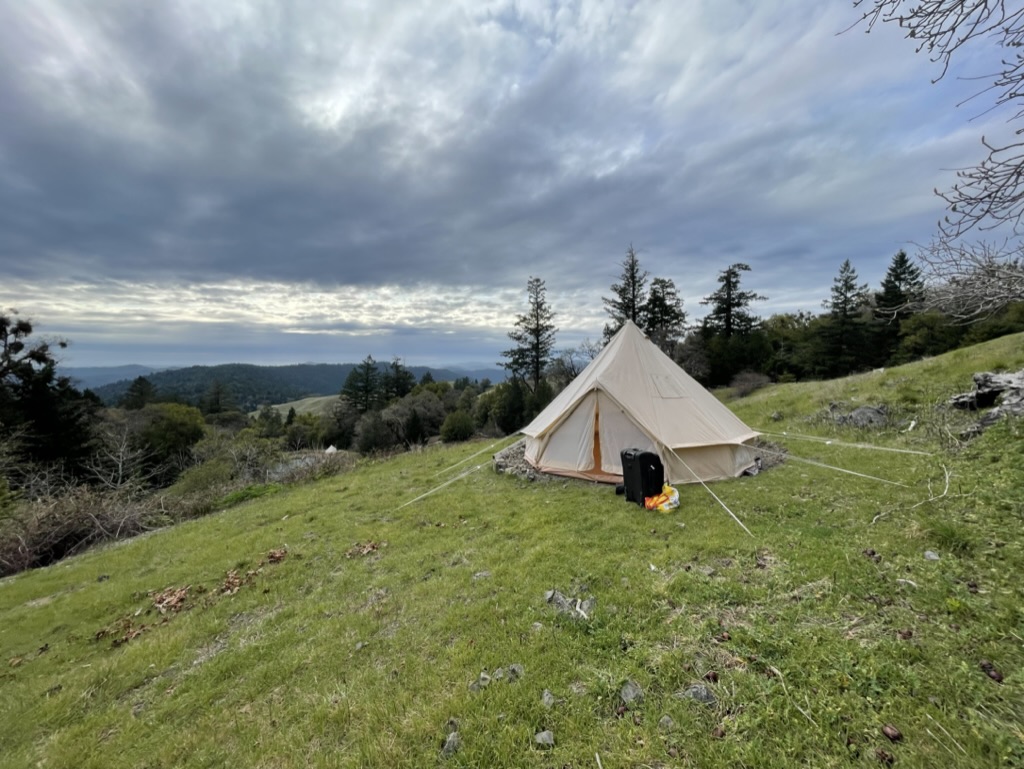
The tent I slept in for two months.
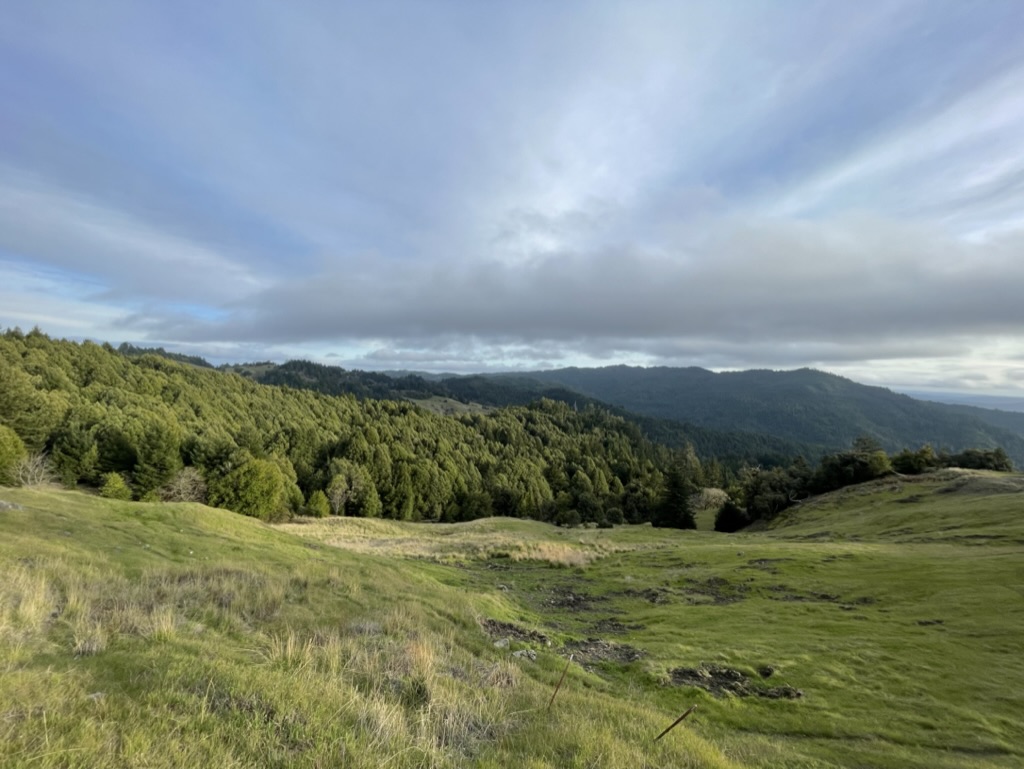
The retreat was held in a beautiful mountain scenery in California.
The Emotional Body: What Emotions Actually Are
Toward the end of the retreat, I began working with Rob Burbea’s recordings from The Boundless Heart. This shifted my attention to what Rob calls the “emotional body” — the axis from root to crown. What became clear through sustained attention is that what we call “emotions” are actually constellations of physical sensations with remarkably consistent mappings:
- Shame: tension in the lower belly
- Fear: tension in belly, throat, and shoulders
- Love/spaciousness: warmth and softness in the heart center
Most of the time, I couldn’t name the emotion. The combination of tensions and sensations was so unique in each moment that conceptual labels felt reductive. This was itself freeing — I stopped trying to figure out what I was feeling and just felt. From Rob, I took the insight that practice doesn’t require cathartic release. You can simply be with the emotional body as it shifts. Watching these constant shifts made something viscerally clear: I am not a conceptual thing. I cannot grasp myself using words or mind. Two techniques from Rob’s recordings proved particularly useful: Spacious holding. Feel the tensions in the body and imagine a soft white bubble of spaciousness around them. This made unpleasant tensions workable rather than something to push through. Playing with views. Rob suggested holding the idea that the world is sacred — lightly, experimentally. After a day of this, everything around me did feel more meaningful. It was subtle but unmistakable how much views shape perception. I also experimented with repeating limiting beliefs aloud (“I need to be a good boy”) until they released into laughter. The belief would just… dissolve.
What I appreciated most about Rob’s approach was the underlying message: everything is just a view. There’s no solid meditation approach you need to twist yourself into like a pretzel. That helped me release my mental image of what meditation and awakening should look like.
IFS on Retreat: Rewiring the Inner Dialogue
For the first three weeks, I practiced Internal Family Systems intensively. The retreat container made this remarkably potent — hours of uninterrupted access to parts that normally stay submerged. I encountered parts with beliefs I’d never been aware of. Again and again, I found myself explaining to various parts that I’m an adult now and don’t live with my parents anymore. This sounds almost comically simple, but the felt sense of parts receiving this information was profound. I also practiced befriending parts directly — asking questions, offering to work together rather than against each other. After three weeks, something shifted. I’d look in the mirror and the voice in my head would say, “You look great, I love you.” I’d drop something and hear, “No worries, I love you.”
The inner critic didn’t disappear, but the default inner dialogue became friendly. My sense is that IFS operates similarly to metta practice. The verbal component gives the mind an illusion of control, which eases resistance. Speaking from Self felt like generating metta — while the voice spoke kindly to parts, tensions in the body would soften and unwind.
Emotional Release: Meeting Anger
We did breathwork every morning on this retreat — screaming, kicking, the full cathartic toolkit. I also set up a punching bag in a small hut on the property. What I discovered: whenever I felt depressed and stuck, punching the bag would leave me feeling more whole and loving afterward. This surprised me. I’d expected anger release to leave me agitated or drained. Through this work, I started to notice a pattern. I’d tap into anger, then fear would arise to block it. But I kept going deeper. At some point I was shocked by how hard I could kick when I actually allowed the anger. I realized I’d been holding back my own strength my entire life, perceiving myself as weaker because of my resistance to feeling anger.
After the first month, I could access anger and fear like never before. I made it a daily practice — one to two hours of feeling into anger and fear through singing, laughing, punching, jumping. From the outside, it probably looked unhinged. From the inside, it was just processing. One observation: societal norms around emotional expression are strange when you examine them. Full emotional expression is considered crazy unless you’re an actor. But on retreat, without social pressure, I found myself walking around singing and laughing by myself. The fear of being judged simply fell away.
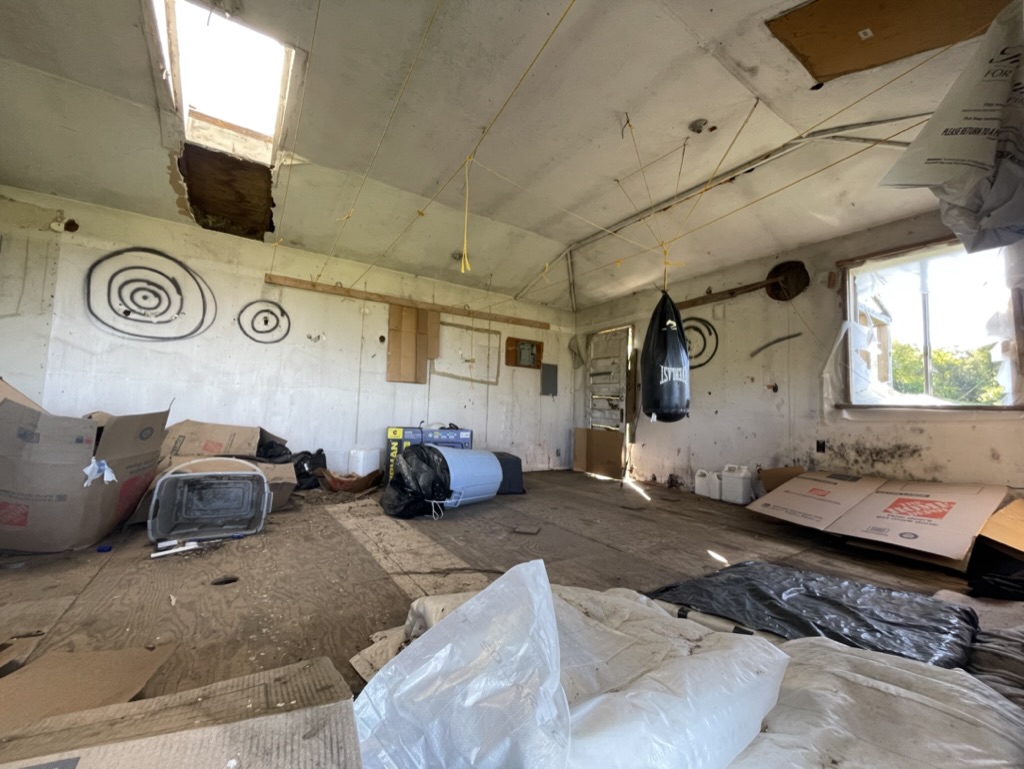
The punching bag in the hut I found.
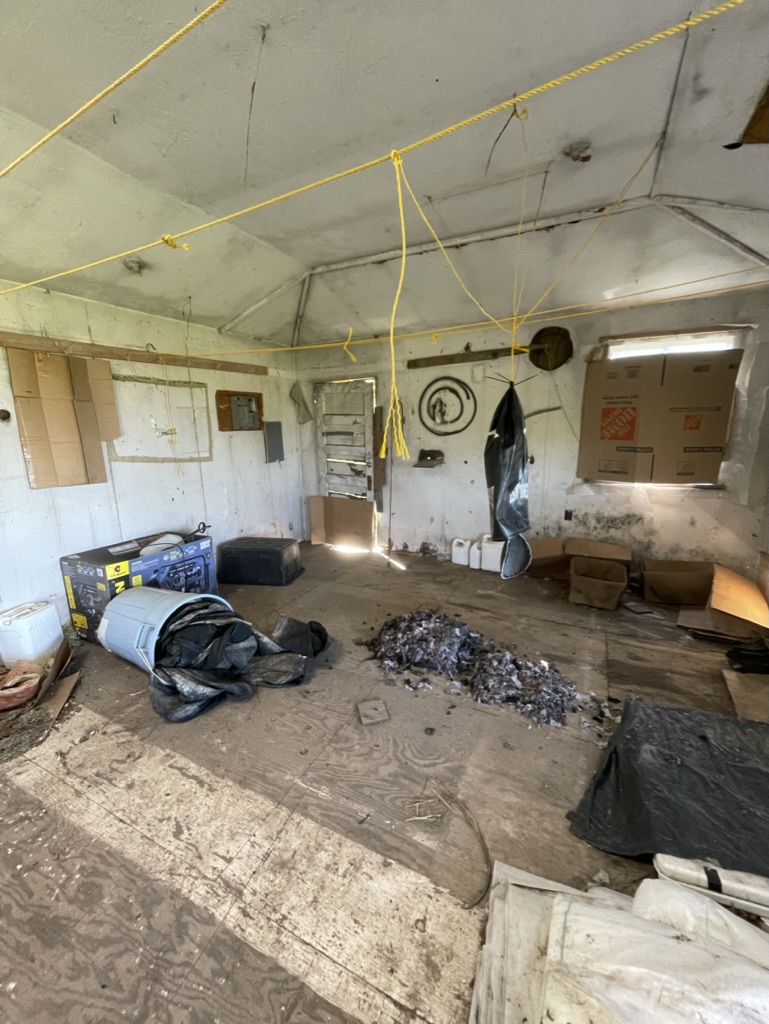
The punching bag after a very freeing anger release session. I didn't expect how much strength there is in my body.
Fourth Jhana and the Deconstruction of Self
My primary practice was metta, radiating from the head in six directions. I’d accessed fourth jhana on a previous retreat and wanted to deepen this. While I didn’t progress to the formless jhanas, sustained fourth jhana practice set certain processes in motion. Over weeks, my body began to feel thinner, lighter, more nebulous. This correlated with my sense of self feeling similarly thin. At some point, my visual field started flickering whenever I closed my eyes or after longer sits. I could glimpse that I was seeing discrete frames of experience. The flickering correlated with subtle tension around the eyes.
Then a connection became clear: the tension around the eyes arose every time a sense of self was created. And this correlated with any shift of tensions throughout the body — the body would take a slightly new shape, and that constituted a new sense of self. Also the distinction between thoughts and body dissolved, my thoughts when I tuned in where the sensations of muscles around the mouth tensing in the pattern that forms words and vice versa. I could tune into vibrating sensations or thoughts and it was like an isomorphism in math.
One insight that sounds obvious but felt deeply freeing: I am living in the present. Each self is created fresh in the present moment. I am not bound by my past. In one sitting, I went through my entire life chronologically and realized something strange: I couldn’t find myself in any of the memories. I wasn’t in them. The one who had those experiences wasn’t locatable now. This was disorienting and liberating in equal measure.
Changes in Awareness
After several weeks, I noticed my awareness had become wider. Looking at a cornfield, I could see the waves of wind across the entire field simultaneously rather than tracking a portion of it. The first time this happened, it felt psychedelic. This persisted after retreat. Watching ocean waves with wide awareness became fascinating — seeing the whole pattern of wave interference at once rather than following individual waves. I also began remembering most of my dreams. And after a few weeks of metta practice, a golden heart started appearing repeatedly in dreams. I took this as a sign the practice was saturating deeper layers.
Multiple Selves: Direct Experience of Plurality
Before this retreat, my life had often felt fragmented — like a movie with fast cuts, chaotic and disorienting. About two years ago, after developing stable witness awareness, it started feeling like a continuous film. On retreat, I got to observe directly that I’m not a monolithic self but a system of parts, as IFS describes. I started by noticing different voices. I’d ask them their names and ages. Then I had the strange experience of noticing co-consciousness — being aware that a different self was operating my body while “I” observed. I could talk to that self and intervene if needed.
The most disorienting experience: I sat down to meditate and began interacting with a friendly inner voice. Then I realized that yesterday, I had been that voice. But today I was identified with a different one, now observing my previous “self” from outside. This could have been terrifying — the realization that my current self could disappear, and I don’t know when or if it would return. Instead, it built trust. While selves, voices, and identity shifted, awareness remained. Safety lies in resting in that which doesn’t change.
Trauma Practice
I came to this retreat partly to work with childhood trauma. Some observations: Stillness as trigger. In the first week, I noticed that extended stillness itself was activating — the body remembered freeze and helplessness. I could hear some fellow practitioners breathing in fight/flight for the first weeks during sitting practice which faded. But I don’t think that is the safest way to ground the body. I introduced movement before and during sits: power stances, fists on legs, pushing arms outward, moving the head. This helped discharge the freeze response.
Root awareness. After several weeks, sexual feelings began arising during sits as awareness moved into the root. I realized I’d never breathed fully because deep breaths bring attention to the root at the end of the inhale, which triggered discomfort. The talk of root chakra as life force suddenly made experiential sense — I’d been cut off from it. I spent many sits just being with these sensations, working through layers until I could hold that energy without being overwhelmed.
Sleep and activation. I noticed that before sleep, fear would arise in my stomach along with root sensations — in hindsight that was fight/flight activation. My lifelong sleep difficulties suddenly made sense: the body replays activating memories before sleep, and I’d spent countless nights on YouTube or other distractions to escape these sensations without knowing that’s what I was doing.
With continued practice, the sensations became less scary. The fear of them had been worse than the sensations themselves. Metta and yoga nidra helped. Eventually, I could go to sleep more easily than I ever had. Also I found parts with extreme beliefs. One part thought it was my father. Many parts held hatred toward me, and working with them took patience. Initially I tried only befriending, but after weeks of continued abuse from certain parts, I began setting boundaries: “You can’t talk to me like that. We can talk when you’re more friendly.” Teaching targeted parts to hold boundaries helped too. Also a lot of shame came up. In my IFS practice I kept repeating to objecting parts: this is not my fault. It’s not any part’s fault.
What Shifted
The retreat gave me more trust in awareness and in my capacity to be okay. I saw repeatedly that fear is usually worse than whatever I’m afraid of. But the bigger shift was a reorientation. I’d come hoping that more metta and jhana practice would bring transcendence — rising above the messiness of human experience. What I left with was the opposite conviction: being with my body, chakras, and emotions is the path. Radiating metta from the head while ignoring the body below isn’t freedom, it’s spiritual bypassing with good concentration.
Practice that brings me down into the body to live my humanity, rather than escape it — that’s what I’m pursuing now. What remains: a deeper trust in life. A changed relationship with time — the retreat felt like a single day, and later I often found myself simply in the present moment without a sense of time. When things get hard, I turned to practice intuitively in the months after. And after the retreat I felt a sense or glimpse how emptiness might be all-encompassing love, and that I might be able to infuse my whole experience with it within this lifetime.
For the other side of this retreat experience — what I learned about the teacher — see When Your Meditation Teacher Becomes the Lesson.